
Horses changed from small, dog-sized forest creatures into the large, single-hoofed animals we see today because their environment shifted from dense woods to open grasslands. This long process of biological adaptation shows how have horses evolved over time by developing specialized teeth for grinding tough grass and long legs for running away from predators in wide-open spaces. It’s a story of survival driven by the need to find food and stay safe in a changing world.
How horses evolved through time
| Stage | What it does | What you notice when it goes wrong |
|---|---|---|
| Eohippus | Grazes in forests | Small size limits reach |
| Mesohippus | Browses on leaves | Multi-toed feet limit speed |
| Merychippus | Eats tough grass | Teeth wear down quickly |
| Pliohippus | Runs on hard ground | Single hoof cracks easily |
| Equus | Travels long distances | High energy needs for movement |
Eohippus relied on dense forest cover for safety, using its small stature to hide from predators. As environments shifted toward open plains, Mesohippus adapted by developing longer legs to navigate varied terrain. This transition necessitated a shift in diet, as softer forest foliage gave way to the abrasive, silica-rich grasses of the grasslands.
Merychippus represents the critical pivot point where high-crowned teeth became essential for survival. Without these specialized molars, the animal couldn’t process the gritty vegetation found in expanding prairies. Later, Pliohippus solidified the move toward a single, weight-bearing digit. This structural refinement allowed for efficient energy storage in tendons, favoring endurance over the agility required in wooded habitats.
By the time Equus emerged, the horse had become a specialized machine for migration. This final stage prioritizes metabolic efficiency, allowing the animal to cover vast distances to find water and grazing patches. When these evolutionary mechanics fail, the horse struggles to maintain its weight or sustain consistent movement.
Tracking the transformation of the horse
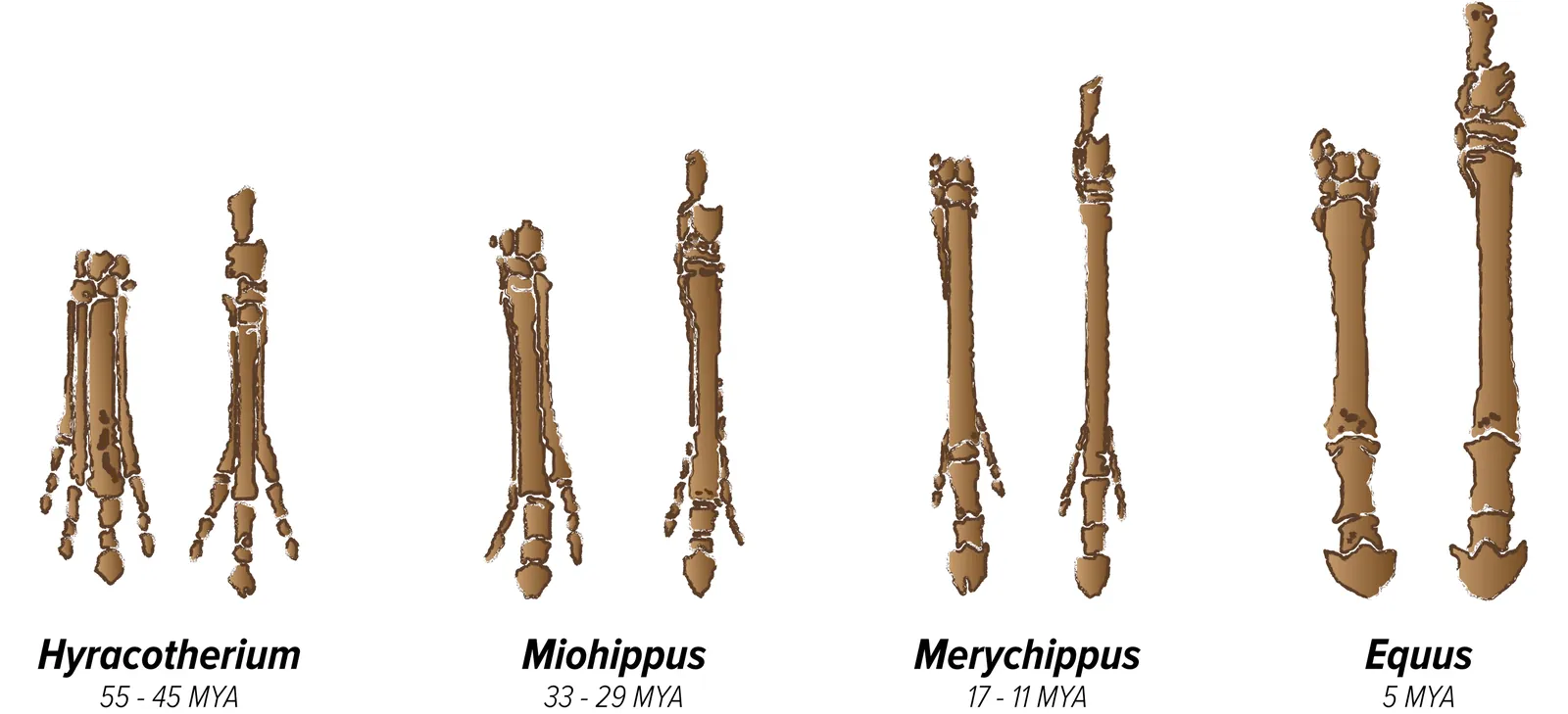
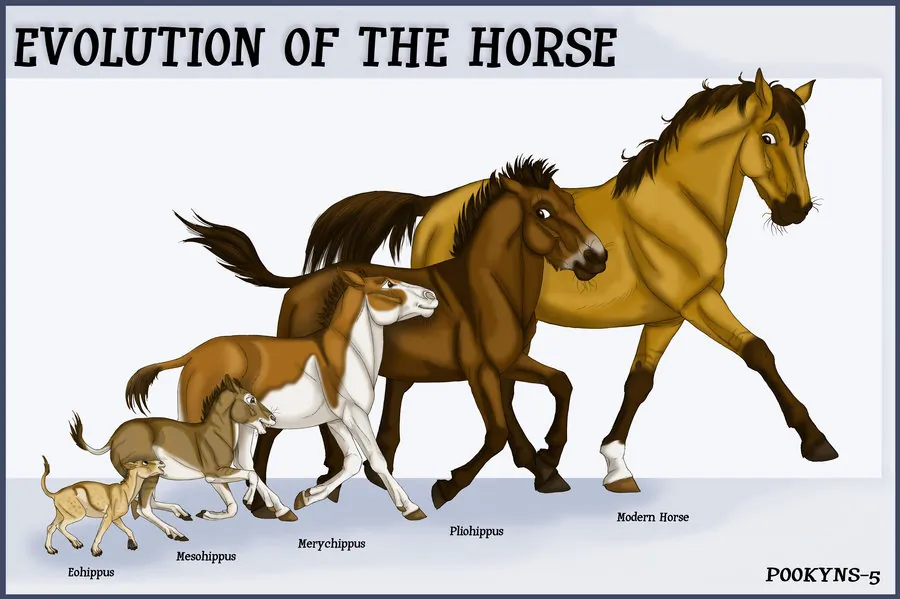
- The Eohippus lived about 50 million years ago, standing only 12 inches tall with four toes on its front feet to navigate soft, swampy forest floors.
- The Mesohippus appeared 35 million years ago, growing to 24 inches tall with three toes, allowing it to stand more firmly on changing, drier terrain.
- The Merychippus arrived 17 million years ago, reaching 40 inches tall and developing high-crowned teeth designed specifically to grind down the tough silica found in prairie grasses.
- The Pliohippus emerged 5 million years ago, becoming the first one-toed horse, which helped it run efficiently across the hard, flat surfaces of open North American plains.
- The Equus genus finally appeared 4 million years ago, refining the body shape into the modern form we recognize, with a large, deep chest and high-speed efficiency.
- The final migration occurred as these ancestors crossed land bridges into Asia and Europe, leading to the diverse breeds that exist in our world today.
Why structural changes define the modern horse
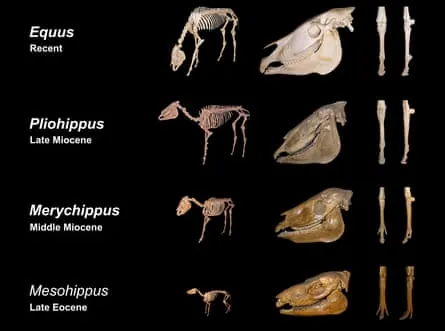
Changes in the horse’s anatomy directly reflect the shift from forest dwelling to grassland grazing. In a forest, a small animal uses four toes to spread its weight across soft leaves and mud, preventing it from sinking into the ground. When the climate cooled and forests turned into open plains, the ground became harder and more compact. This required a different way of moving to escape predators like early wolves or big cats.
The transition to a single hoof is the most important change for survival on hard ground. A single, solid hoof acts like a shock absorber, allowing the animal to gallop at high speeds without breaking bones or sinking. If a horse today had the soft, multi-toed feet of its ancient ancestors, it would quickly suffer from severe foot pain and lameness on modern paved roads or hard-packed dirt trails.
Teeth also changed to match the available food source. Forest plants are soft, but grass is abrasive and contains silica, which acts like sandpaper against enamel. The development of high-crowned teeth allowed horses to grind this tough material without wearing their teeth down to the gums. If you look at a horse’s mouth today, you see a long line of flat, grinding molars that are a direct result of this evolutionary pressure to process fibrous prairie grasses.
Control and constraints in equine biology
What you can influence
- Diet quality: You can provide supplemental forage to mimic natural grazing cycles.
- Exercise surface: You can choose soft or firm ground to protect the animal’s joints.
- Hoof care: You can use metal or rubber shoes to prevent excessive wear on hard surfaces.
- Breed selection: You can choose specific types bred for speed or endurance based on your needs.
What is fixed by design
- Digestive system: The horse is biologically limited to a hindgut fermentation process that requires constant grazing.
- Skeletal structure: The single-hoofed limb can’t be modified to support heavy loads without risking stress fractures.
- Respiratory limit: The horse’s airway is fixed in size, which limits oxygen intake during extreme, prolonged exertion.
If you’re concerned about your horse’s specific physical limits, consult a licensed equine veterinarian for a professional assessment, as these biological traits vary by age and individual health.
Habits for modern horse owners
Modern horse care relies on understanding that these animals are still built for the open plains. Because they evolved to eat small amounts of forage almost constantly, keeping a horse in a stall for 20 hours a day often leads to digestive issues like colic. Providing access to forage for 16 to 18 hours per day helps keep their sensitive gut moving as nature intended.
Movement is equally vital for their long-term health. Since their ancestors ran miles every day to find water or escape danger, a horse kept in a small paddock without room to move will often develop stiff joints. Aim for at least 2 hours of movement or turn-out time per day to ensure their circulatory system functions correctly. If your horse seems lethargic, check their heart rate and hydration levels, as these are the primary indicators of physical stress.
Frequently asked questions
How long does it take for a horse’s teeth to wear down?
Horse teeth grow throughout their lives, but they wear down at a rate of about 2 to 3 millimeters per year depending on the coarseness of their diet. You can check the specific wear pattern by looking at the occlusal surface of the molars during a dental exam.
Is it safe for a horse to run on concrete?
Running on concrete is unsafe for a horse because their hooves and joints are designed for soil and grass, not hard, non-yielding surfaces.
Why do horses have only one toe?
Horses have one toe because it provides the most efficient leverage for running on hard, open ground. This single digit acts like a spring, storing and releasing energy with each stride, which allows them to reach speeds of up to 40 miles per hour when threatened by predators.
Can horses survive in a forest environment?
Horses can’t thrive in dense forest environments because their digestive and locomotor systems are specialized for open grasslands.
Does the horse’s size matter for its survival?
Size is a critical factor in a horse’s survival because larger body mass allows for more efficient heat retention and better defense against predators. You can determine the ideal weight for your horse by using a weight tape to measure the heart girth and body length, then comparing it to standard breed charts.
What happens if a horse stops moving?
A horse that stops moving for extended periods faces a high risk of digestive stasis and joint stiffness. Because their heart relies on the pumping action of the lower legs to move blood, inactivity leads to fluid buildup in the limbs, which you can identify by pressing your finger against the leg to see if a pit remains.
Conclusion
Today, we can still see these ancient traits in how horses move and graze across our fields. If you’re interested in learning more, you should visit a local stable or a nature preserve. It’s a great way to appreciate how they’ve adapted to thrive alongside us in our modern world.