
Scientists believe that the absence of horses in America for several millennia was primarily due to these environmental changes following the last ice age.
Where horses were in early America
| Evidence type | What it indicates | What you notice when it goes wrong |
|---|---|---|
| Fossil record | Proof of historical existence | Missing or misidentified bone layers |
| Sediment layers | Age of the discovery | Soil mixing confuses the timeline |
| Genetic data | Ancestry of modern breeds | Contamination ruins the DNA sample |
| Climate proxies | Environmental conditions at time | Local data lacks global context |
| Tool artifacts | Presence of human hunters | Lack of clear hunting marks |
These indicators serve as the primary diagnostic tools for paleontologists reconstructing the North American landscape before the terminal Pleistocene. The fossil record provides the physical anchor, yet it remains vulnerable to geological shifts. When stratigraphic layers are disturbed by water or seismic activity, the chronological placement of equine remains becomes unreliable, leading to significant errors in dating.
Genetic data offers a deeper look into evolutionary divergence, though it requires pristine conditions. Modern lab techniques rely on ancient DNA preserved in permafrost or dry caves. If a sample is exposed to contemporary biological material, the resulting sequence becomes a mosaic of modern and ancient markers, rendering the data useless for mapping ancestral lines.
Climate proxies, such as fossilized pollen or ice cores, explain why these herds vanished. They reveal the rapid shift from expansive grasslands to dense forests, which restricted the grazing range of early horses. Without this global context, researchers might mistake a localized drought for a continent-wide extinction event.
Finally, tool artifacts bridge the gap between biology and human impact. Archaeologists look for specific butchery patterns on bone surfaces to confirm if humans accelerated the decline. If these marks are absent or ambiguous, it suggests the population collapsed due to environmental pressure rather than overhunting, highlighting the complex interplay between climate change and early human migration.
The cycle of extinction and return
The Pleistocene epoch ends, causing rapid warming that shrinks the grasslands horses relied on for food, forcing them into smaller, isolated pockets of habitat. As these meadows fragmented, the animals lost the migratory corridors essential for escaping seasonal droughts or localized resource depletion.
Human populations expand across the Bering land bridge, introducing efficient hunting techniques that target large mammals already stressed by the changing climate and shrinking environment. This pressure wasn’t merely about the number of animals killed, but the disruption of herd structures that protected younger, vulnerable foals from predators.
Horse populations decline sharply as their reproductive rate can’t match the combined pressure of habitat loss and hunting, leading to local extinctions over several centuries. This decline created a demographic bottleneck where populations became too sparse to maintain the social cohesion required for effective group defense.
The remaining small groups fail to find enough genetic diversity to survive, eventually disappearing from the North American continent entirely by the early Holocene period. Without a critical mass of breeding individuals, inbreeding depression likely accelerated their final collapse.
Centuries pass with no equine presence, leaving the North American landscape to evolve without the influence of large grazing animals for thousands of years. This absence fundamentally altered soil composition and plant succession patterns, as the natural cycle of seed dispersal and nutrient cycling provided by equines vanished.
European explorers arrive in the 16th century, bringing domestic horses on ships, which eventually escape or are traded to indigenous groups to repopulate the plains. These animals thrived because the ecological niche remained vacant, allowing them to reclaim the vast grasslands that had been empty for millennia. Their return wasn’t a restoration of the original species, but a biological reintroduction that reshaped the continent’s entire cultural and environmental history.
Why the absence became permanent
The disappearance of the horse wasn’t a singular event but a collapse of a complex ecosystem. As the climate shifted, the lush, wide-open grasslands of the Pleistocene transformed into forests and tundra.
Horses, which are specialized grazers, struggled to find sufficient forage in this new landscape. This environmental stress made them vulnerable to the arrival of new, highly skilled human hunters. Because the horses had not evolved alongside human predators, they lacked the specific defensive behaviors needed to avoid these new threats.
The Smithsonian National Museum of Natural History documents this long history of equine development and eventual disappearance from the continent. When the last of the native horses died out, the ecological niche they occupied remained empty for thousands of years.
This long gap explains why the continent seemed so strange to early European arrivals who expected to see horses but found none. The absence was a result of a “perfect storm” of biological and environmental factors that wiped out the species completely.
This vacancy persisted because the North American landscape lacked the specific migratory corridors required for horses to recolonize from Asia. While other megafauna like bison successfully navigated the changing terrain, the horse’s reliance on specific, high-quality grasses made them less adaptable to the mosaic of emerging habitats. They were trapped by their own dietary requirements.
Furthermore, the lack of horses fundamentally altered the soil composition and seed dispersal patterns across the Great Plains. Without the constant grazing and trampling of large herds, the vegetation became denser and more prone to wildfires. This created a feedback loop that prevented the return of open prairie environments for millennia.
By the time humans began to manage the land more intensively, the horse was already a distant memory. The continent had effectively locked itself into a new ecological state that excluded equines until the colonial era.
Limitations and human influence
What you control
- Preserving fossil sites to ensure future study.
- Mapping geological layers to track historical shifts.
- Supporting ethical research into ancient DNA analysis.
- Protecting modern habitats for wild horse populations.
What is fixed by design
- The timing of the original climate shifts.
- The biological requirements for horse survival.
- The geological record of the Pleistocene epoch.
Attempting to excavate or study fossils without proper training can destroy evidence that belongs to the public record. If you find bones, contact a local university or natural history museum instead of disturbing the site yourself.
Habits for understanding the past
Tracking the history of North American land mammals requires looking at changes in soil and pollen samples. These environmental clues act as a proxy for climate shifts that dictated where herds could migrate or survive.
Because horses leave very specific tooth wear patterns, researchers look for these marks in fossilized remains to determine what the animals ate. If the wear patterns suggest coarse grasses, the region was likely a grassland; if they show signs of soft leaves, the area was forested.
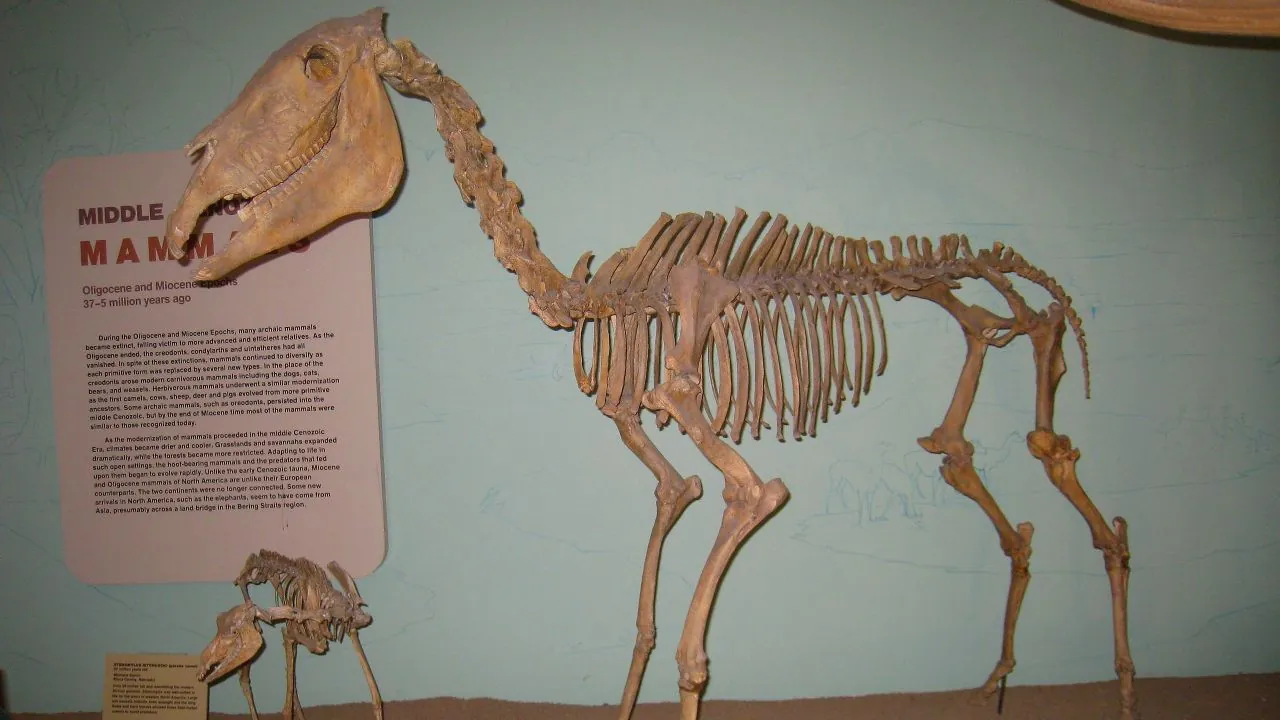
You can see these trends by visiting public museum collections that display the transition of these species over time. When viewing these displays, look for the density of the enamel ridges on the molars. A higher density often indicates a shift toward grazing on abrasive, grit-heavy prairie grasses, which forced the animals to evolve more durable teeth.
Always check the official signage at these sites to understand the specific era being described, as dates vary by region. If you find a gap in the timeline at a local museum, consult the site’s geological survey records instead. These documents often detail the specific sediment layers where equine fossils were recovered.
By cross-referencing fossil teeth with the surrounding soil composition, you can reconstruct the local landscape as it existed millions of years ago. This method reveals why certain regions supported massive populations while others remained barren. It transforms a static museum display into a dynamic map of ancient migration routes, helping you visualize the continent before the horse vanished.