
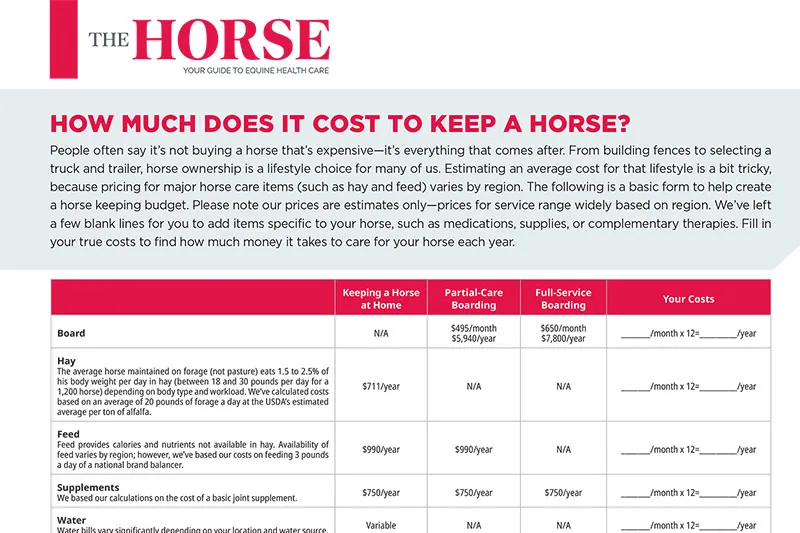
Boarding a horse generally costs between $300 and $1,200 per month, depending on the level of care and the location of the facility. This price range assumes a standard monthly contract in the United States; for areas with high land values or premium amenities, you should expect to pay at least 30% more. Your final bill depends on whether you choose full-service care or self-care.
A guide to what it costs to board a horse
Self-care costs $200–$400 monthly, but you must provide all feed, bedding, and daily stall cleaning. If you can’t visit the barn twice every single day to manage these chores, choose a higher tier. Neglecting daily mucking leads to expensive hoof rot and creates poor air quality that can contribute to respiratory issues.
Partial-care runs $400–$700 monthly, where the barn handles feeding and turnout while you manage mucking. Full-care costs $700–$1,200+ monthly for total labor and supplies.
Pasture board ranges from $250–$500 monthly for horses living outside with shelter and hay access. This is the healthiest option for most horses, provided the fencing is secure and the herd is compatible.
Expect $50–$150 in extra fees for blanketing, supplement administration, or holding for the vet. Always clarify if these services are per event or per month before signing a contract.
Why boarding prices differ so much
The variation in monthly boarding fees stems primarily from the cost of labor and the quality of the facility’s infrastructure. A barn that offers full-service care must pay staff to manage feeding, turnout schedules, and stall maintenance seven days a week. These labor costs are the largest component of the monthly invoice. If a facility includes high-end amenities like an indoor arena, climate-controlled tack rooms, or round-the-clock security, those overhead expenses are passed directly to the owner.
Geographic location also plays a significant role in pricing. Boarding a horse near a major metropolitan area often costs double what you would pay in a rural region due to the price of land and the tax burden on property owners.
You should also consider the trade-off between convenience and control. If you value your time, paying for full-care is the logical choice. If you’re on a strict budget and live close enough to visit twice daily, self-care or partial-care allows you to lower your monthly outflow.
Be aware that self-care requires you to be physically present every single day, regardless of weather or personal illness. If you can’t make it to the barn, you’ll need to pay someone else to cover your duties, which often negates the savings.
When the boarding cost changes
| Situation | What changes | What to do instead |
|---|---|---|
| Urban location | Higher land rent | Board in rural areas |
| Full-service needs | Labor costs rise | Choose self-care options |
| High-end training | Facility fees increase | Use a private stable |
| Medical requirements | Extra care charges | Negotiate flat-rate contracts |
| Seasonal forage | Hay costs spike | Buy hay in bulk |
When stable owners raise prices, determine if the hike reflects rising overhead or declining service quality. If the increase exceeds 10% annually, verify if your horse’s specific needs still align with the facility’s current business model.
Most owners fail by ignoring the “hidden” surcharge for specialized medical administration. These fees often compound during winter months when turnout time decreases and stall time increases. If you pay for individual medication delivery, request a flat-rate contract to lock in costs before the peak season begins.
If your facility transitions to a high-volume boarding model, your horse may lose critical one-on-one attention. In this case, moving to a smaller private barn often provides better value, even if the base monthly rent appears higher on paper. Always prioritize consistent care standards over minor fluctuations in base board pricing.
How to board your horse properly
- Tour the facility: Walk through the stalls and pastures to check for safe fencing and clean water. Look for signs of neglect, such as empty hay nets or messy barn aisles.
- Review the contract: Read the document to see what is included in the monthly fee. Ensure the agreement clearly states who pays for emergency vet visits and farrier services.
- Check feed quality: Ask to see the hay being fed to the horses. If the hay looks dusty or contains weeds, it may cause respiratory issues or malnutrition over time.
- Observe the horses: Look for animals that are calm and well-groomed. A facility with happy, healthy horses is a sign that the management understands proper equine care and routine.
- Horses usually need at least 8 to 12 hours of turnout to maintain their physical and mental health.
- Discuss security: Inquire about how the barn is secured at night. A good facility should have a locked tack room and a plan for fire safety that staff are trained to follow.
The mistakes that ruin a boarding relationship
- Ignoring the contract: Failing to read the fine print can leave you responsible for hidden costs, like manure disposal or arena usage fees.
- Underestimating the time: Choosing self-care when you have a busy job often leads to missed feedings, which hurts the horse’s health and creates tension with barn management.
- Not asking about extras: Assuming basic board covers blanketing or holding the horse for the farrier often leads to surprise charges on your monthly invoice.
- Ignoring the social environment: Joining a barn with a negative culture can make your time there stressful, even if the facility itself is physically perfect.
Related guides
Frequently asked questions
Can I save money by choosing self-care?
Yes, you can save money, but only if you have the time and equipment to manage the work yourself. Self-care is usually the cheapest option, but you must buy your own feed, bedding, and cleaning tools. If you have to hire help because you’re busy, you’ll quickly spend more than you would have on a full-care plan.
How long should a horse be turned out?
A horse should ideally spend at least 8 to 12 hours outside every day to stay healthy. Being in a stall for 24 hours can lead to digestive issues and muscle stiffness. Always check if the boarding facility guarantees specific turnout hours in the contract, as some barns limit time outside during bad weather.
What happens if I forget to pay the board?
Most boarding facilities have a late fee policy outlined in their contract. If you miss a payment, you might be charged an extra 5% to 10% of your monthly rate. Repeated late payments can lead to the termination of your boarding agreement and the potential loss of your stall at the facility.
Does the board price include vet care?
No, basic board doesn’t include routine or emergency veterinary care. You’re responsible for paying the vet directly for vaccinations, dental work, and any injuries. Some barns offer a service where staff will hold the horse for the vet, but they will charge you a separate fee for this labor.
Is it safe to board in a pasture-only facility?
Yes, pasture boarding is safe for most horses as long as there’s adequate shelter and constant access to clean water. Horses are social animals and often thrive in a herd environment. Ensure the pasture is properly fenced and that the horses are fed enough supplemental hay during the winter months when grass is scarce.
How do I know if the barn is right for me?
You’ll know the barn is right when the management is transparent about costs and the horses appear well-cared for. Talk to other boarders at the facility to see if they’re satisfied with the service. If the current boarders are happy and the facility is clean, it’s likely a good place to keep your horse.
Conclusion
Boarding is a significant financial commitment that requires you to balance your budget against the specific needs of your horse.