
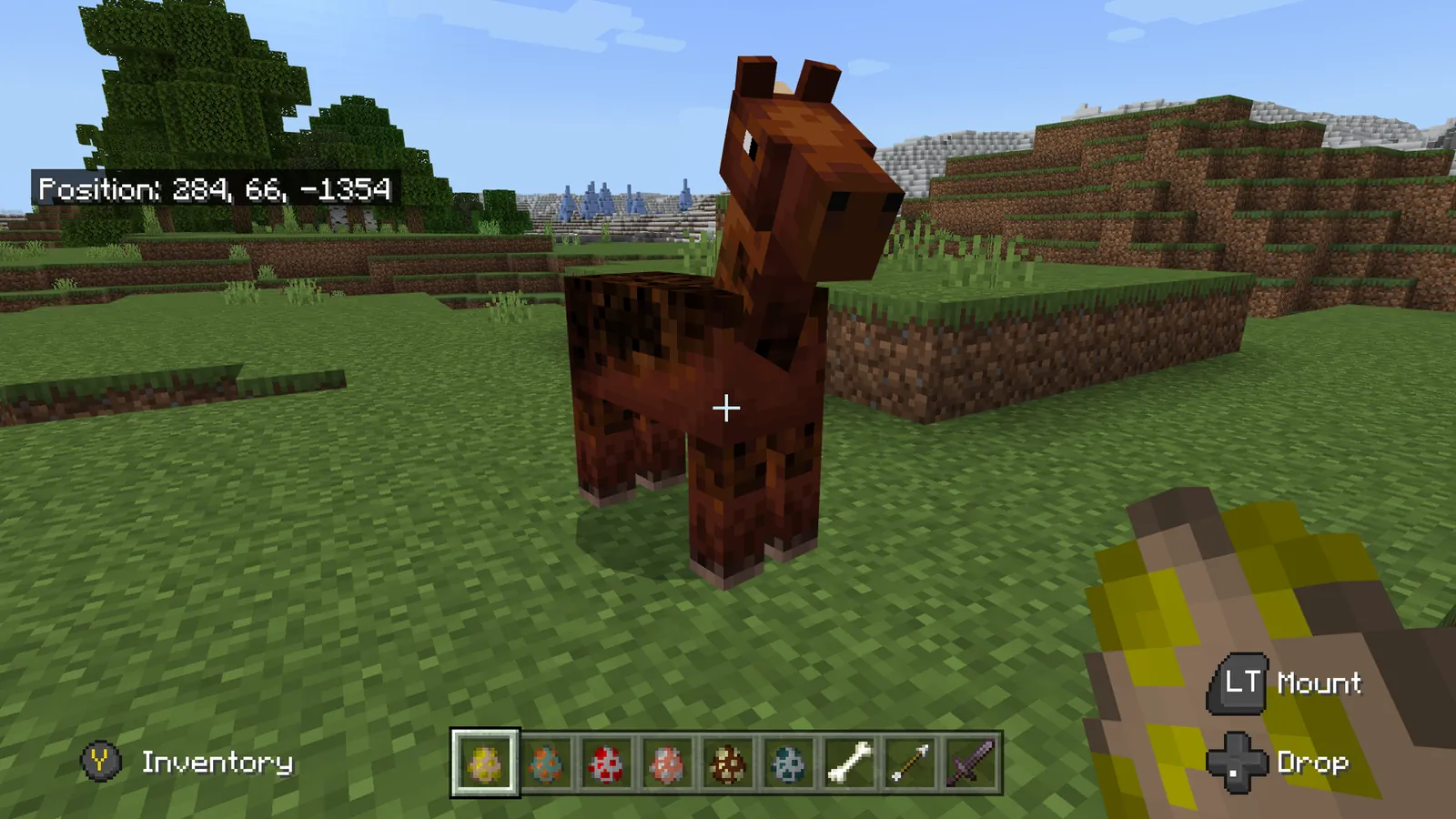
For most people, the easiest way to find horses in Minecraft is to walk across a plains or savanna biome and look for them in the open grass. Horses spawn there in small groups, so you’ll usually spot one within a few minutes of walking.
If you’re already deep in a forest or desert, taming a donkey or mule is the better move. Donkeys spawn in the same plains and savanna, so you can often tame both on one trip.
Horses also spawn in villages, which makes them worth checking even when the surrounding terrain is wrong. If you find a village, look at the animal pens before you leave.
The mistake is searching at night. Mobs fill the dark and you’ll walk past horses without seeing them. Go at dawn instead.
Horse-finding methods compared

Every method below works, but they don’t cost the same amount of time or effort. The table shows what each one really asks of you, from a simple walk to a full breeding setup.
| Method | How long | Effort | Cost | Best for |
|---|---|---|---|---|
| Walking plains or savanna | 5–15 min | Low | Low | Your first horse |
| Exploring with a map or boat | 10–30 min | Medium | Low | Finding a specific color |
| Breeding two tamed horses | 20+ min | High | Medium | A fast, strong horse |
| Trading with a villager | Varies by village | Medium | Medium | Getting a horse without exploring |
Walking wins on effort, breeding wins on quality, and trading depends on whether a village near you has the right villager. None of them wins every column.
Walking plains and savanna biomes
This is the method most players use first, and it works because horses spawn naturally in these open biomes.
- Craft a map if you don’t have one, or just pick a direction and walk.
- Head toward flat, grassy land — plains, savanna, or sunflower plains.
- Look for groups of 2–6 horses standing together in the open.
- Approach slowly and feed one a golden apple or wheat to tame it.
- Put a saddle on it once it’s tamed, then ride it home.
The strength here is speed and zero setup — you need nothing but open ground. The weakness is luck: if your spawn point is surrounded by jungle or desert, you might walk a long way before you see anything.
Give the search a time limit. Walk in one direction for two in-game days, and if no horses have appeared, turn back and try a different heading rather than pressing on.
Taming fails often before it succeeds, and each failed attempt still costs a golden apple. Wheat is the cheaper option while you’re learning, and it works just as well — save the apples for when you have a stack to spare.
Horses also spawn in windswept savanna and in villages, where one may already be penned behind a fence. A village horse is the fastest find of all, since you skip the search entirely.
If you have no saddle yet, tame the horse anyway and lead it home on a lead. Saddles come from dungeons, mineshafts, and trading, not from the horse itself.
Using a boat or map to cover ground
When walking isn’t finding anything, a boat on a river or ocean lets you cover far more distance in the same time.
- Craft a boat from 5 wooden planks.
- Follow a river or coastline outward from your base.
- Watch the shore for plains or savanna edges.
- Dock the boat and walk inland when you spot green, flat land.
- Mark the spot with a torch or a map marker so you can return.
This is good when your home is near water and you want to explore several biomes in one trip. Its weakness is that you can’t tame or lead a horse while you’re still in the boat, so you’ll make a second trip to bring it back.
Rivers are the better choice when you don’t yet know the terrain, because they cut inland and pass through more biomes than a straight coastline does. A coast is faster, but it only shows you what sits on the water’s edge.
Sail at night if you want the trip to pay for itself. Hostile mobs spawn on land, not on open water, and the ones that do reach you’re easy to outrun. You’ll pass a lot of shoreline that looks the same, so pick a direction and hold it rather than turning at every green patch.
Carry a spare boat. If yours breaks against a bank or you step out on a slope and it drifts, you’re stranded a long walk from home.
Breeding two tamed horses
If you want a horse with better speed or health, breeding two tamed horses gives you a foal with a chance at stronger stats.
- Tame two horses using wheat or golden apples.
- Feed each one a golden apple or golden carrot to trigger love mode.
- Let them stand close together — a foal appears shortly after.
- Feed the foal golden apples to speed up its growth.
- Repeat with the best offspring until you get the stats you want.
The payoff is a horse built for long journeys. The catch is time — you’ll spend a while feeding and waiting. If you’d rather skip the breeding loop entirely, trading with a villager who sells horses is a rare but real shortcut.
Which Minecraft way to find horses fits you
Pick based on what you actually need right now, not on which method sounds best.
If you’re in a hurry, walk plains or savanna first. It needs no items and no setup, so you can start the moment you decide to look.
If it’s your first time, walking is also the safer choice. You’ll learn how horses behave and how taming works without risking anything you’ve built.
If you want the best possible result, breed two tamed horses. It takes longer and costs golden apples, but the foal can inherit better speed and health than a wild horse.
The trade-off is always the same: quick and simple gets you a horse, while slow and careful gets you a good one. You rarely get both at once.
What matters no matter which method you pick

A few things apply whether you walk, sail, breed, or trade. Get these right and every method goes smoother.
Horses need a 2-block-tall space to move through, and they can’t climb. Build a simple fence pen before you bring one home, or it’ll wander off. The Minecraft Wiki’s horse page lists the exact spawn biomes and taming items if you want the full detail.
Before you leave, carry wheat, a golden apple, and a saddle. Check partway through your trip that you still have food — taming fails if you run out. At the end, lead the horse into the pen and close the gate before you dismount.
If you’re playing on a server, check its rules on horse spawning and trading first, since some servers change them.
Frequently asked questions
How long does it take to find a horse in Minecraft?
Usually 5–15 minutes of walking in a plains or savanna biome, assuming you start near one. If you spawn in a jungle, desert, or ocean, it can take much longer because horses don’t spawn there.
Can horses spawn in the desert?
No. Horses spawn in plains and savanna biomes, not deserts. If you’re standing in sand, walk toward green, flat land — that’s where you’ll find them.
Is it safe to tame a horse near other mobs?
Yes, taming itself is safe. The risk is hostile mobs at night, so tame during the day or bring torches and a weapon to clear the area first.
What happens if I feed a horse the wrong item?
Nothing bad — it just won’t tame. Horses tame with wheat, sugar, apples, golden apples, or golden carrots. Other food does nothing.
How many horses spawn together?
They usually spawn in groups of 2–6. If you see one, look around; there are likely more nearby.
Why can’t I find any horses in my world?
You’re probably in a biome where they don’t spawn, like a forest, desert, or snowy area. Walk to a plains or savanna biome and search there instead.
Do I need a saddle to ride a horse?
Yes. You can tame a horse without one, but you can’t control where it goes until you put a saddle on it. Saddles come from dungeons, mineshafts, or trading.
Conclusion
Walk toward open grass first, and you’ll usually have a horse within minutes. Only reach for breeding or trading when walking fails you or you want a stronger animal.